“Daily Sightings” A Blog

The vibe.

Wednesday, March 2nd, 2011

Sometimes you get a feeling about what you’re going to see, and what you’re not going to see, even before you enter the woods. Call it a vibe.

It’s unscientific, but undeniable. Today, the vibe said no birds.

Still, I want to get into this wilderness. An old Midwestern oak forest. It’s the country that fur-hunting Voyageurs explored in the 1600s. Deep, quiet, wild.

The Voyageurs were two-fisted Frenchmen who came through in canoes. Between rivers, each guy would carry a hundred pounds of pelts through the buggy woods.

The woods look the same today. In winter, you can bushwhack without bugs. I do this, and notice tracks in the snow. Deer mostly. But some are freshly made by a coyote. They’re sharp-edged. He’s probably watching me. I don’t see him.

I don’t see birds, either.

I’ve come to a spot near the brown, partly frozen river. A familiar place to sit on a fallen tree and think about things. Or, to sit and think of nothing, which is better. Some people call it meditation, when you think of nothing. That word doesn’t come naturally for me.

I won’t see geese and ducks on the river. Not today. I won’t see a Pileated Woodpecker. Or Red-bellied and Hairy Woodpeckers. No Downy Woodpeckers.

This could be blamed on the time of year, or maybe the time of day. But not really. Hell, on other occasions at this time of year and this time of day, I’ve seen plenty of birds.

A Great Blue Heron freezing his feet on ice. A Belted Kingfisher flying over the thawing river, letting out a croak that was more dinosaur than bird.

I’ve seen a rare Northern Shrike when the vibe was right. Tufted Titmice, Red-breasted Nuthatches, a Horned Lark, an Eastern Bluebird that didn’t migrate. Forest Robins that also didn’t migrate.

On days when I saw these birds I expected to see birds. I could feel it.

Today, nothing. And I knew it would be that way. That’s okay. I wanted to sit, watch the river, and think of just that: nothing.
You’re no Bar-headed Goose.

Wednesday, February 23rd, 2011

A flight of imagination…

You beat the Himalayas. You did the tedious training. Made one boring base camp after another. You acclimatized.

Your team members got sick with lung clots and quit.

You strapped on oxygen and wrapped yourself with rope. You wore dark goggles against snow blindness.

You wore clunky, cleated boots. You look like a spaceman. You could be on Mars.

Your heart’s beating funny, your lips are bleeding. Your blood is not working right; you feel sick. It’s minus 42 Fahrenheit.

But you got to the top of Mount Everest, over 29,000 feet, highest viewpoint on the planet.

You’re king of the hill.

The sky is so blue it’s dark; you’re close to space. Climbers have died trying to reach this viewpoint. You’re nearly dead yourself.

Without oxygen, you’d keel over. But you’re here. Nobody’s higher. Wait a second….

A shadow passes over you.

Above, a flock of geese cuts in front of the sun. Geese? Above? Your goggles aren’t lying.

The geese are flapping along in V-formation, hundreds of feet higher than where you’re standing. For them, it’s another day at the office.

The wind that’s hitting you with 90 mile-per-hour gusts is at their backs. They streak over, fat and happy.

You look up, sucking oxygen, leaning on your ice pick like an old man leans on a cane.

Maybe you need to know your place. You aren’t made for this. You’re no Bar-headed Goose.

“Bar headed.” Good name. Makes you want to head for a bar, just thinking about what they do.

You might be imagining that you’re on Everest, but there’s nothing imaginary about these two-fisted birds.

Bar-headed Geese are known for high altitude migration over the Himalayas. Their blood has special hemoglobin. They laugh at anoxia as they fly in the jet plane lane.

From your viewpoint on the mountain top, they might notice you. But to them, you wouldn’t be king of the hill.

Just some clown that’s beneath them.

My book report.

Saturday, February 19th, 2011

This big bird book came in the mail. It came here because we write about birds, and people who are interested, including you, read the stuff we write.

The publishers of this big book, Princeton University Press, figure that if I write about it, you’ll see it and maybe you’ll buy the book. I’m an ad guy. I understand this.

I’ve worked, at one time or another, for Madison Avenue ad agencies. New York ad agencies, Chicago ad agencies. My territory included big board rooms and big bored rooms.

All the ad nuttiness you see in movies about ad agencies. The running for planes and trains. The filming in Hollywood. The demanding clients and eccentric bosses. The eccentric clients and demanding bosses.

The fondness for an unpleasant liquid called midnight oil. The fondness for a pleasant liquid called vodka. Whoa. How’d I get on that rant…

Oh, yeah, I understand advertising. The need to put a product in front of its target audience. Well, Princeton also understands. I was happy to get this big bird book.

Due to a condition I can only describe as weirdness, I will sit down and read a bird book like a novel. Always did. Even as a kid.

I also would sit down and read a novel like it was a bird book.

What the hell does that mean? Try it some time. It means you notice field markings about all the characters, you remember their names, and look for their types and traits when you get out into the world.

Getting out into the world becomes really necessary when you work in advertising. Or read bird books like they’re novels. Or read novels like they’re bird books.

Life inside the cubicles, conference rooms, airports, studios and martini hangouts of the ad world does nothing more than make a guy want to get into the woods as fast as possible, as often as possible and as deep as possible.

To get away from the smoke, tech talk, buzz words, booze buzz, flip charts, the power points, meetings, phones…the eccentrics around you and the eccentric inside you.

And reading novels like they’re bird books or bird books like they’re novels makes you want to jump out of your skin and your old chair, and head for the woods.

Indoor work and reading are fine and necessary, but make outdoor exploration even more necessary. Whoa, how’d I get on that rant…

Oh, yeah. I’ve got a book report due.

Like any schoolboy, I’m stalling. But that’s not fair to the big book. I love the book.

I really respect Princeton University Press. The name “Princeton” alone, is worthy of respect, being in the Ivy League and all. I wonder why they call it the Ivy League. All college buildings have ivy growing on them…

And the word “press,” well, it means all kinds of things. Like in basketball, for example. When I used to play, and man, did I have a shot, I would hate the full court press.

Or even the half court press. Hate doing it to the other team. Hate having it done to our team. I was all about shooting. Playing offense. Whoa….the book.

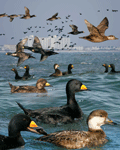
It’s called the Crossley ID Guide. Eastern Birds. It’s the best-looking bird book I ever saw. Too big to carry around for some people, but a two-fisted lug can manage it. This book’s not a field guide anyway; it’s an “ID” guide. It’s made for birding at home. You can read it like a novel.

black_scoter

With pictures. A million pictures of a million birds from a million angles in their actual surroundings.

For better book reports about this big book, please check just about every other bird blog in the world. They were sent copies, too, and are better at this than I am.

Meanwhile, I’m going to curl up with my Crossley ID Guide. Then go for a long hike.

The bird that waited.

Wednesday, February 16th, 2011

I’m in the snowy woods north of Chicago. I see deer grouped tightly nearby. Their winter coats are surprisingly thick. I notice fox and coyote tracks.

Foxes keep a low profile these days. Smart. Coyotes are on the increase, and can be cannibals. Just ask the little dogs in my neighborhood. If you can find ‘em.

While I stand here freezing my butt off, my mind wanders to a warmer place…

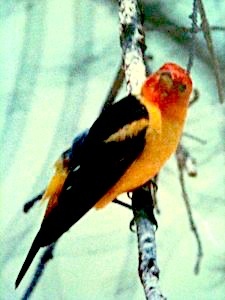
I remember hiking in the summertime Gore Range of northern Colorado. I like Scarlet Tanagers, and had hoped to see one of their cousins there, a Western Tanager.

My wife and I were enjoying mountain views at every turn in the trail. The peaks were snow covered. High altitude snow, bright in the June sun.

There were other memorable views: In the distance below, I saw a couple skinny-dipping in a stream. The girl was Colorado personified. The guy, well, who cares?

Later, there was a Western Tanager. Very close. On a branch, eye level. It was like he’d put himself there to be seen. My wife whispered, “Quick, get your camera.”

The camera was in our Jeep, way down the trail. I could never get it, get back, and expect the tanager to still be there. I said, quietly, “No way. Too far.”

She urged, “Quick, go get the camera.” I sighed. Many minutes later I was back with it. Beyond all reason, the tanager had waited. I aimed, focused, “click.”

National Geographic would never be calling. But there was a moment between the bird and me.

The tanager had looked in my lens, clearly saying, “What the hell took you so long.” Then he flew.

The memory of that moment is strong in these cold woods today. The tanager had waited.

My wife reminds me that she played a major role in this.  She’s right, as usual. You shouldn’t always assume that an opportunity will fly away.

That’s my daily sighting, although it didn’t happen on this day. Nothing much happened today. But it was still great to be in the winter woods. It’s always great.

Jurassic Kicker.

Saturday, February 12th, 2011

My banjo teacher, Bob, sent me a copy of National Geographic’s February issue.

There’s an article in it about dinosaur feathers. Bob probably thinks I could put its pages to better use than the pages of sheet music he gives me, which I mangle.

He’s right. The article is made for bird watchers.

Last September, I wrote “A kick in the Jurassic.” It resulted from my seeing a Nova TV show reporting new evidence about birds being evolved dinosaurs.

Not evolved from dinosaurs. Evolved dinosaurs.

I liked hearing that these monsters from time-travel adventure might’ve had feathers. And we’ve been wrong to think of them as reptilian looking.

Now, Nova’s initial explorations into this subject have been supported and updated by some detailed reporting in National Geographic.

The article shows dinosaurs with feathers. There are fossil photos, too, and their meaning is explained. A gatefold reveals the family tree of dinosaurs and birds, and dinosaur-birds. It’s almost like a field guide. Good illustrations.

The science is pretty clear: there were dinosaurs that looked like gigantic walking, stomping, roaring birds. Lots of colors, too. Like I said, you could use it as a Jurassic field guide.

The old view of dinosaurs as oversized lizard-oids, might have been plain wrong. Spielberg probably shouldn’t have had his stars running around naked.

If these large feathered animals morphed into pint-sized sapsuckers, bustards, gnatcatchers and turkeys, cool. Saber tooth tigers the size of humvees gave way to cougars. Sloths the size of elephants became sloths the size of raccoons. Evolution goes where it wants. T-Rex is an Emu.

If you doubt this connection between birds and dinosaurs, just get up close to the next Great Blue Heron you see. Look into its eyes.

The killing grounds of early earth will stare back at you. Better not stand too close to that beak.

Snow on the mind.

Wednesday, February 9th, 2011

The woodlands are snowed in, so I’m snowed out.

But no. I give it a try. Hiking in the wild is like a drug. You can’t go cold turkey.

Speaking of cold turkeys, they’d make a nice sighting. I saw some in a field. But that wasn’t today. Today, I’m the only turkey around.

It’s quiet. Too white in the sunshine, not good for the eyes. All this sameness, the stillness, and your mind starts to wander.

Your feet can’t wander. You can hardly move on the buried trail. But the mind moves fine.

It takes me back to another snowfield where the white and quiet were similar. But the air was thinner.

I was on a mountain in Colorado. I’d seen Black-billed Magpies there. Mountain Bluebirds, Pine Grosbeaks, a distant Golden Eagle, Gray Jays. Not much else.

Snap back to the present: there’s some modest activity here. Cardinals, Dark-eyed Juncos, a distant flock of what might be Cedar Waxwings.

And I’m surprised to see pale Robins toughing out the winter. Maybe they took global warming to heart, and didn’t migrate. Maybe they’re from farther north.

I take a breather. And think about the mountain.

When I was in that other snowfield, up there, I almost saw a mountain lion. Lions are a goal. I’m always looking when I’m on their turf.

I have a friend who saw a mountain lion on a golf course in Tucson. Sorry, that doesn’t count. A lion shouldn’t be on a golf course.

When I was on the mountain, there were fresh prints. The lion was probably watching me from cover.

Back to the Chicago burbs. Our forests are deep, and you could be anywhere, even the wild west. No lions, but coyote tracks are common.

Robert Frost wrote: “Whose woods these are I think I know.” I’m not a guy who quotes poets. But I know whose woods these are.

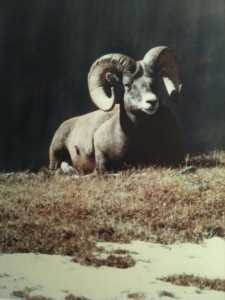
ram

Back on the mountain, after not seeing a lion: I saw a bighorn ram. A lion would have been better. Still, the ram’s no slouch.

I had my old camera. My photos are nothing much, but they show that I was there.

I wrote my name in the snow to show that I was there, too. But that’s another story. And it’s long gone.

Speaking of being long gone, it’s time to get out of the woods. This wandering of mind and body in wilderness and time was nice. My only drug.

But back to reality.

Odd birds. And a football footnote.

Saturday, February 5th, 2011

We hear about odd birds in odd places.

A Green-tailed Towhee was spotted on a Rhode Island beach in winter. This West Coast bird is not just out of its range; it’s out of its mind.

An Anna’s Hummingbird is in Pennsylvania. Another warm weather bird that belongs in the west.

There’s enthusiasm for these sightings among birdwatchers who are also twitchers. Twitchers go where the odd birds are.

Oddities happen. Years ago, I saw a buck with a misshapen antler over its face. Like a pretzel that came out of the factory funny.

And I saw a Canada Goose grazing with others, even though it had an arrow through it. Oddities remind us that the world’s not always okay.

By contrast, I saw Cardinals and Black-capped Chickadees today on the sunny side of our snowed-in home. They were drinking from our icicles. Nothing odd about them. They belong here. They’re expected.

If I saw an odd bird hanging out with them, a Scott’s Oriole for example, I’d have mixed feelings. It would be like watching an accident. My twitcher friends get twitchy eyelids hearing this.

When I was on Mount Lemmon in Arizona, I saw a Scott’s Oriole. It was supposed to be there. This yellow and black bird verified my location. All was right with the world.

When you get off a plane in Denver, there are Black-billed Magpies. In England you see Great Tits. Like I say, birds verify our sense of place.

I’m not wild about a western hummingbird freezing its ass off in Pennsylvania, or a towhee in Rhode Island. These guys have a screw loose. I hear about them, and think of the deformed antler or skewered goose.

I prefer the cold Chickadees and Cardinals surviving on icicles where they live. Nothing odd in that.

Footnote:

Speaking of odd happenings in odd places. Why should Green Bay and Pittsburgh play the Super Bowl in Dallas? Not their territory.

The trophy should go to the team that wins, say, the best two out of three games. And they should play in their own stadiums.

Odd sightings may make nature interesting. But nature can’t help it. Football can. Enough oddness. Green Bay and Pittsburgh busting their butts in Dallas?

Most fans won’t even be able to go. They’re not twitchers.

Canned birdsong.

Friday, January 28th, 2011

A town in California is considering adding birdsong to its streets via loudspeakers. To make citizens happier.

It’s California, so this might be no joke.

What if it catches on? What if big cities like Chicago and New York fill their streets with pre-recorded birds?

And which birds would be singing? White-throated Sparrows or Hermit Thrushes? American or European Robins? Nightingales at night? Screaming Bald Eagles when we’re militant? Mourning Doves on a sad day? Maybe a vote should be taken.

And what about unforeseen side effects…

Real birds could think rivals are encroaching. Avian turf wars are common, and this could push nervous birds over the edge. Maybe some would just pack up and leave. Let humans have their stupid electronic birds, we’re outta here.

But even if the town’s birds were indifferent, would the canned song really make people feel happier?

Some people like it quiet. Others will find the taint of elevator music in all this. Maybe background sounds aren’t the government’s business. Unless we’re talking about lawn blowers at 7 am.

But as goofy as the bird song initiative might be, there’s some logic in it.

When ad guys shoot outdoor TV commercials, they add birdsong. It’s a stock sound effect called “sweetening.” Imagine two commercials, one with birds and one without. You’ll like the bird version better.

It’s more finished, more real, happier. Yeah, happier.

And when you’re putting a music track behind the action, you have certain instruments that can do the same “happier” thing. Like the banjo.

I’ve done this when making TV commercials. I’ve added a subtle banjo riff in with the other instruments. It makes the music sound American. And happy.

Maybe that town in California could skip the birdsong project with all the questions it raises, and just add banjo to their streets.

A little “Oh Susanna” twanging along as you walk to the corner store has got to make the day sunnier, and you happier.

And if you’re lucky enough to also hear a Hermit Thrush, you’ll know it’s real. Another reason to be happy.

“Avi-fauna.”

Sunday, January 23rd, 2011

It’s below zero and snowing. That shouldn’t stop a two-fisted birdwatcher from tramping around the woods.

But combine it with the biggest football game ever, and this will be a stay-at-home Sunday.

That doesn’t mean there won’t be bird sightings.

Just when I think that avifauna will not figure into my day, I find a folded NY Times travel section at my door.

It was put there by my friend, Avi. This guy’s name is not short for “avian” or anything relating to birds. The newspaper story is about birds of India, the place of Avi’s birth.

Looking at photos on the crinkled page, I could sense jungle humidity, smell rivers; imagine the sounds of insects and unknown birds.

The smoky red sun is near. So are cobras, jackals, elephants and birds created by Picasso—a guy who was not Indian, but who took liberties with the way we see things.

A Paradise Flycatcher looks like he’s been assembled with the parts of four other birds. There are Malabar Whistling Thrushes, White-throated Kingfishers, small Jungle Owlets (not baby owls, this is the name of the owl species) and the tallest flying bird in the world, the Sarus Crane. Dr. Seuss helped Picasso with that one.

The biggest crane made me stop thinking about the biggest football game ever—at least for a few minutes. And I felt uncharacteristically bird-illiterate.

I’ve seen birds in Europe and Russia, the Pacific, Caribbean and Alaska. I know what it’s like to visit another guy’s field guide. So what caused this feeling of avian illiteracy? India!

There are 1,200 species there, compared to our 900. And most are exotic. There are two ways to deal with this.

One, we say, “weird!” and forget about it, comfortable with our daily Red-tailed Hawks, White-breasted Nuthatches and Great Blue Herons. The red, white and blue.

Or, two, we say: Let’s go to India. A whole different ball game of avifauna awaits in the Western Ghats…the jungles and shorelines of Goa where I’ve heard there are lions. And in the Annamalai Hills where there are Hornbills.

Not sure I’m up for it, but if I ever do go bird watching in India, I’ll ask Avi to come along for the ride. He’s got the right name for it.

Birds of hell.

Wednesday, January 19th, 2011

Today I looked at two Cardinals in a sleet storm. The sleet changed to snow, and the temperature dropped through the thirties, twenties and into the teens.

Then the wind started. This is Chicagoland. Another way of saying: where hell freezes over.

We’re used to it. The Cardinals are used to it. I gotta hand it to them. They’re the type that would sit through a Bears game at frozen Soldier Field.

Whoa. Cardinals, Bears; we’re mixing our NFL teams.

Sure, there’s an NFL team called the Cardinals, but they play in Arizona where it’s warm.

Little known fact: these Arizona Cardinals were once the tough old Chicago Cardinals, and played in freezing Comiskey Park on the city’s South Side.

My dad went to see them there, and bought hotdog sandwiches, two in each hand. Not to eat, although he wanted to. But to stuff inside his shirt for insulation.

A two-fisted football fan.

Back to the avian brand of Cardinals…I looked at these colorful birds and thought: you’re good-looking, red, with the pointy crest. Nobody’d blame you if you headed out of town with the orioles, tanagers, swallows and thrushes.

But you’re too ballsy.

I see other die-hards, too. Crows, Juncos and wild northern Robins that tough it out here in flocks.

And the unsung heroes: drab House Sparrows, also known as Weaver Finches. These are common worldwide, so they must be doing something right. Same goes for Rock Doves, known as city pigeons, or rats with wings. Give ‘em a break; they’re street tough.

I also see unflappable Herring Gulls sitting on Lake Michigan icebergs. Chickadees, Titmice, you know the cast of characters; you’ve got it down cold.

Plus hardheaded Hairy, Downy and Red-bellied Woodpeckers. Imagine pecking a tree when it’s frozen.

We gotta hand it to these tough birds. I raise a glass to them. I need it after walking around in the cold.

The birds don’t need that kind of help; they’re the two-fisted ones. The Cardinals, and all the others who go about their business when hell freezes over.

I saw a deer hide.

Saturday, January 15th, 2011

This happens when you go bird watching: You see more than birds.

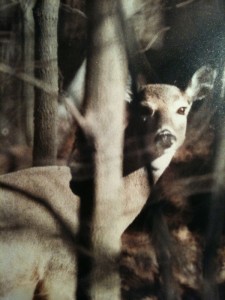
The deer peeking around a tree struck me as funny. Looked like she was trying to hide. But the tree was skinny and she wasn’t.

I had a camera that day, and got the shot. I keep this picture on the wall in a room where I work out.

deer tree

Every time I look at it I smile. I’ve looked at it a thousand times.

This gets me wondering about why we stay interested in the same old things…

Yesterday I saw an American Kestrel on a wire. I stopped the car. Got my binoculars, and looked.

Cool sight. A “sparrow hawk,” as it used to be called. Fierce eyes. Tan like a cougar, with blue and gray markings. Two-fisted talons, the talons of a welterweight.

The Kestrel stared at me: “What the hell you loookin’ at?” Then turned his head, opened his wings and lifted off like a warplane.

I’ve seen Kestrels before. I’ve seen a lot of birds. It’s memorable when you see one for the first time. You lose your bird virginity, so to speak. But you don’t lose your interest.

I remember the first time I saw a Bald Eagle. Near a lake in the North Woods. I was excited. But the second time, I still was excited.

My first Scarlet Tanager was a score. But so were the tanagers I saw after that. Even the ones I saw last May, though they were far from my first.

Serious birders keep a list of species. I do that, too, in the form of check marks in an old field guide.

But I also keep a casual list of repeat sightings in the back of my mind. Every time I see an interesting bird, a little click registers somewhere.

Another Red-breasted Nuthatch. Another Hairy Woodpecker. Another Turkey Vulture. I don’t have exact figures, but I appreciate each sighting.

Maybe some day I’ll get jaded and stop raising my binoculars. Maybe I’ll figure, “Seen it all.” But not yet.

So I looked at the American Kestrel on a wire, and he looked back. I thought: What’s better than seeing a thousand Kestrels?

Seeing a thousand and one.


Nuts.

Monday, January 10th, 2011

There’s a story on this website called “Tits.” The word means different things to different people. And the story gets a lot of visits.

“Nuts” is a similar word. Several meanings. This word has come to mind recently for three reasons.

One.

Our latest Hidden Bird Contest features a Clark’s Nutcracker. It’s pretty well hidden. I thought it would be hard to find, so I headlined the contest: “A hard nut to crack.”

Turns out, I was nuts to think that.

In the first week of January, we had more people find the hidden bird than we usually get in a whole month.

Two.

This got me thinking about the first time I found a Clark’s Nutcracker, myself.

It was in a pine tree on the side of a Colorado mountain. Not that hard to spot, and I got a good look.

mbbjpg2-150x150I also saw a Mountain Bluebird that day, another first. I took its picture.
This fuzzy photo doesn’t cut it when compared to those taken by digital-telescope cameras.

A real photographer might bust a guy’s nuts for showing a shot like this. But I never said I was good. Just that I was there.

Three.

We discovered an email problem around here, and it drove me nuts.

It seems that several comments sent to us recently had been trapped by an over-zealous spam filter, and they were auto-deleted.

We receive most emails okay, but even one that gets lost is unacceptable. If it were yours, you wouldn’t have gotten a reply.

You would have felt “e-gnored.” (“Ignored by email.”) If you’ve been “e-gnored,” it was unintentional, and won’t happen again.

Thanks for sending in your comments, and for playing our Hidden Bird Contest.

I still think this month’s contest is a hard nut to crack. But even if I’m wrong, it’s always cool to spot a Clark’s Nutcracker.

Daytime Owl.

Thursday, January 6th, 2011

My wife and I are walking in the woods with a young couple we’d invited over. The couple’s in love, about to get engaged.

I know my way around, and could navigate these woods in the dark. But it’s bright daylight. That’s why it’s unusual that we see an owl.

Romeo and his girl spot it, and point it out. I’ve seen owls at night, but this was a first. It looked down on us, awake, but without much interest.

Owls are above it all. They’ve even got an edge over eagles. This is because they can play eagle, either day or night.

They’ve got broad wings for soaring. And they can pick up animals of all sizes with steel-trap talons. (You wouldn’t want to shake hands with a two-fisted owl; you’d come away bloody, or minus a finger).

Owls have a reputation for being wise. But they also have a reputation for bad luck if spotted during the day. Well, it wasn’t me or my wife who found it; we were just along for the ride. Would that matter?

This Great Horned Owl had miles on it. Shaggy, dirty gray. Huge, with eyes that didn’t mind daylight, and stared you down. Its “horns” stuck up hard and pointed. The chest was broad.

Interesting as hell, but not a good-looking bird.

We’d also seen a Red-headed Woodpecker, White and Red-breasted Nuthatches, several Hermit Thrushes, and a shy Woodcock that walked like a chicken.

There was beaver sign. Deer were in the distance. Coyotes had our scent, and knew our plans.

As we wandered back to the parking area I thought about the bad luck thing. Would our car be there? Would we have a flat? Would we have unseen tick bites that would bring disease later? Was there such a thing as owl-induced bad luck?

Bull.

It was a great hike. We saw some birds and got to spend a couple of hours outdoors with the loving couple. When they broke up a few days later, I saw no connection to the owl sighting. At least, nothing I’d admit.

2011 Space Odyssey

Sunday, January 2nd, 2011

Space. Cold. Goes on as far as you can see. It’s not the final frontier. It’s the only frontier: the wild land where I hike around, looking for signs of life.

It’s a mix of fields and woods along a river. I know its trails, and even know my way off-trail. I’m here on this day to see what there is to see. Like always.

It’s a new year. Maybe I’ll start it by finding something notable. But this is a slow time for birds. A lot of them are on vacation.

I’m content to spot the usual Dark-eyed Juncos, Black-capped Chickadees and Cardinals. Also, the Downy Woodpecker that likes to hide on the other side of any tree.

Still, there’s always a chance that something uncommon will show.

I’ve seen a Northern Shrike here. Also, Horned Larks, Snow Buntings, Evening Grosbeaks. And a Pileated Woodpecker, big, with a prehistoric head.

A Great Blue Heron glowers at me while ill at ease on solid ice. He’s clearly pissed that he hasn’t headed south.

I like this hike, even if it turns up nothing new. 2011 is young yet. “2011.” Sounds like science fiction. At least there are still birds, still wild spaces, in this futuristic year.

(See The Ferruginous Hawk for some fictional musing about this, if you want).

These wild spaces are timeless. They look the same as they did last year, a hundred years ago, five hundred years ago.

I move through a snowy clearing where I notice tracks made by deer and coyote living out wild lives in 2011. A Red-tailed Hawk circles overhead.

Wildlife activity in here is so predictable that it’s kind of reassuring. This is because the change of year hasn’t changed a thing.

This space is what it was, what it’s always been. Just what I expected. Sometimes, getting what you expect is all you can expect. No complaints.

In fact, I’ll try to get back tomorrow for more of the same. Next year, too, not that another new year would matter here.

Stumped.

Sunday, December 26th, 2010

Disney World in frigid Florida. We’re here to celebrate the season with a family vacation.

I’m doing “naked bird watching,” which means birding without binoculars.

I get questions: “Hey, are those crows?” “No,” I say, “Turkey Vultures.”

Vultures are common as mouse ears at Disney.

As we move around, I notice Boat-tailed Grackles, Black Vultures, Little Blue Herons, and a Limpkin on a golf course.

I don’t say “Limpkin” to anyone. Stupid bird names make bird watchers sound stupid, themselves. Limpkin?

The kids in our clan ask about stork-like birds that walk around the place. ”They’re Ibises,” I say.

Soon, a five-year-old is shouting, “Can I give a potato chip to the Ibises?” This turns heads.

As days pass, I’m asked about other birds. I have all the answers, but don’t worry: I’m headed for a fall.

Meanwhile, I’m quick with names: “A Snowy Egret,” I say, “A Common Egret, Forster’s Terns, a Bufflehead, a Water Pipit, a Man o’ War.”

(I even spot an armadillo in the palmettos. Not all wildlife sightings involve wings.)

When somebody incorrectly points out a cormorant, I say, with great patience: “No, that’s an Anhinga.”

Hubris is raising its fat head in the land of the Ibis.

Then, one bright cold morning there’s a flock on Bay Lake that’s so unusual, even my most uninterested kin are interested. “What are those?”

And I just don’t know.

They look like ducks, but ride too low. They’re cormorant-like, but aren’t. Not Anhingas. Loons don’t congregate. I’m silent.

There are thirty of them, floating in tight formation, watched by Ring-billed Gulls. They have an upward tilt to their heads, grayish light and dark plumage.

I’m stumped.

Later, I check my field guide. Horned Grebe. This was a tricky identification for two reasons.

In winter, Horned Grebes change from bright colors to gray. Also in winter, they tend to flock. I didn’t know that.

This worked out okay. For a while there, I was becoming an authority figure, and didn’t much like the feeling.

I’d rather be a father figure. Fathers, as we know, don’t necessarily have all the answers.

Bull Watching.

Tuesday, December 14th, 2010

One of the reasons I got interested in bird watching as a kid is that I liked the idea of flying. Superman stuff.

When I started playing basketball, I worked to get enough spring so I could grab the orange metal hoop of a basket. It’s ten feet. I’m not quite six, so that’s flight. Sort of.

But the other night I saw a guy on a basketball court who really could fly.

Derrick Rose, a smallish guard on the Chicago Bulls wears the number one, and he’s number one on the team, maybe in the whole NBA. Because he flies.

Rose did a move that reminded me of a Northern Harrier I’d seen recently. Anti-gravity in action.

There’s a guy on the Lakers named Pau Gasol, seven foot something, and he reached high for a rebound, his gigantic wingspan making it easy.

Gasol’s hand was over the basket, about to scoop the ball as it came off the rim. Then Derrick Rose…rose.

He’s only six-three, so you’ve got to call it flying. He’s suddenly above Gasol. Rose’s hand is above the rim, and he grabs the rebound.

I had to rewind, see it again. My interest in bird watching and basketball had linked. This was a sport about flying, and here was a guy who could do it.

I’d seen Rose make amazing dunks before, and knew he could get up there, but this rebound over Gasol could’ve gone from the sports channel to the nature channel.

It’s about a Peregrine Falcon out-maneuvering a Turkey Vulture. A Blue Jay dive-bombing a Raven. Small outperforming big. Strong beating heavy. Flight beating height.

Years ago, there was a Celtics star actually named Bird. But he didn’t fly. When I watched Larry Bird, the phrase “bird watching” never occurred.

But watching Derrick Rose fly over Pau Gasol and snatch that rebound away, man, I thought about birds. I also thought about Superman, but this is a bird website.

So we’ll leave it at that.

Grousing about Birding.

Thursday, December 9th, 2010

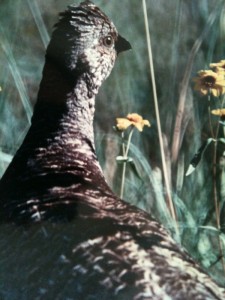
In the grasslands of Colorado, I found myself trailing a Sharp-tailed Grouse. I had a long lens, and took its picture. Not great by today’s standards, but it grabbed the moment.

I was watching a grouse. Did that mean I was “grousing?” Hell, no. I know what grousing means. I’m well known for doing it. Just ask my wife.

This got me thinking about the word “birding.” I generally don’t use it, preferring the term “bird watching.”

I was grouse watching. Not grousing. I was bird watching, not birding. When I’m monkeying with something, I’m not watching monkeys. If I were, I’d call it monkey watching.

These days, there’s an increasingly popular practice of “verbing” nouns. See? The noun “verb” was just used as a verb.

Time out…

This is a two-fisted site. Discussion of English usage is going to wind up with a bloody nose if it’s not careful. So we’ll be quick.

Others may go “birding.” That’s cool. I like these birders. I’m impressed by how good some of them are. But I’m going to stick with “bird watching,” if it’s all the same. And it is.

This probably wouldn’t be worth discussing if “verbing” hadn’t gone too far recently. For example: A business acquaintance said he was “dialoguing” about something. Give me a break.

“Parenting” has wormed its way into common talk. (Yeah, “worm” can be a verb. But at least it doesn’t mean “worm watching”). Anyway, don’t parent; just be a parent.

One final example: “tasking.” Those toadies on TV’s “The Apprentice” are “tasked” to do some degrading thing, then they “task” each other, too.

Enough.

While hiking in Colorado I also saw a Golden Eagle, Steller’s Jays, a novel Gray Jay—uninteresting to look at, but a first for me—and I got close-up views of a Clark’s Nutcracker and Western Tanager.

I saw them while “bird watching.” Many people who share my interest in these sightings would call what I did “birding.” I guess there’s room enough out there for both terms. But you know how I feel.

Meanwhile, we’re done dialoguing about this.

Bird Unemployment

Saturday, December 4th, 2010

I’m on the trail. It’s snowing. No birds. That’s okay. Before I’m done, maybe I’ll see some. For now, I’m just glad to be in the woods.

Sometimes, you need a break from the world of people and its problems. This morning, CNN was going on again about unemployment. I clicked off and came here.

Yesterday, an under-employed buddy wrote to say his job search had switched from plan B to plan C. Then he outlined plans D, E and F. This would be funny if there wasn’t truth in it.

But in the woods, there’s no CNN, no statistics, just snow, trees and maybe some birds. Then a thought starts to form…

There aren’t many birds in here. I hadn’t been seeing variety or numbers earlier in the year, either. Even during migrations, when the place should be crawling.

And it hit me: a lot of birds have lost their jobs, too.

The Red-headed Woodpecker I used to see in a dead tree near the creek? His position has been eliminated.

The Brown Thrasher I’d spot in a field near here every summer? His long-tailed, beady-eyed ass has been downsized. The field he worked in was manned by a skeleton crew of kingbirds, goldfinches, and a few sparrows.

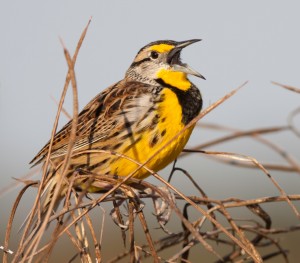
meadowlark

Same thing with meadowlarks. I grew up seeing them everywhere, with their yellow and black chests. These guys must have taken early retirement.

I wade through the deepening snow, watching for unseen hollows and fallen sticks. You never know when something unexpected is going to trip you up.

I see cold Robins. I believe they miss the good old days when they’d winter further south, but they’re sticking it out. No travel budget?

There’s a Cardinal, still on the job. This red bird on a snowy branch is an ornament, and good for the spirit. I see some juncos, and a single crow with a good immune system. Nothing special.

I was hoping to find a Red Crossbill. This uncommon pinecone-eater could be here. I move to a stand of evergreens and wait. Let’s see if the crossbill still has a job.

But the way things are going, I count myself lucky to have seen that Cardinal.

No problem.

Monday, November 22nd, 2010

I went into the woods to think through a problem. What was the problem? I’ll get to that in a minute.

The woods were gloomy and cold. The way I like them. No bugs, bare trees. Quiet. Other hikers are my kind of people. But it’s better in here without them.

There’s a damp smell of rotting leaves. The sky is gray, low and unfriendly. I have a buddy who gets happy when the sun shines. This isn’t his kind of day.

The woods mean serious business. They’re unconcerned with my presence or problems. If I keeled over, they’d just go to work on the new ground litter. This thought is interrupted by sudden movement…

A big hawk swoops across a clearing on my left, low to the ground, then arcs upward and lands on a branch. I get a good look. It glares back.

I said, “Who ya starin’ at.” I knew this bird. It had white on the small of its back. A bright and sizable patch. If this hawk were a girl it would have a curly tattoo there.

The hawk doesn’t smile at this thought. It’s pissed that I’m in these woods on a day when people don’t visit. Screw that. I’m here. And I know its name.

It’s a Northern Harrier, but I call it a Marsh Hawk. That’s what it was called when I was a kid. Bird namers—a sore point with me—changed this sensible name to the archaic “harrier.”

It blinks, turns in disdain and flies off without a sound.

I see a few other birds in the woods. If this were a movie they’d be extras. Little drab winter extras. Juncos and a Brown Creeper. A shy Downy Woodpecker. A flock of cold Robins wondering why they didn’t go south.

But it was the hawk’s movie.

I head to my car, leaving the murky forest on a day when nobody else wants to be there. I vaguely remember planning to think through a problem. What was it? Doesn’t matter any more. Couldn’t have been that important.

It’s a great day. I’m going home to watch football and have a few beers. I saw a Marsh Hawk. Also known as a Northern Harrier. We glowered at each other. No problem.

The four-eyed dweeb.

Wednesday, November 17th, 2010

There’s a new birding blog started by a guy we know. He’s pretty good at this sort of thing. We contributed an article to it recently. The article is called: “The Ornithologist Who Started A War.”

It’s about a U.S. president who also happened to be a two-fisted bird watcher. Kind of fun to write; might be fun to read about. You decide.

The website is “North American Birding.” There’s a link to our story at the bottom of this post. If you’re interested, take a look, and from there you can explore the rest of  “North American Birding.”

Meanwhile, here’s a short excerpt from the piece…

“The Ornithologist Who Started A War.”

I saw a sign on my hike this morning. It said: “dedicated nature preserve.” I also saw a Fox Sparrow.

Those two things got me thinking about a nerd who changed his image and started a major war.

This guy’s more interesting than the Hairy Woodpecker, Red-Bellied Woodpecker, Dark-eyed Juncos and the shivering late-season Eastern Bluebird that I also saw.

The sign reminded me of him because he started a conservation movement resulting in national parks and bird sanctuaries.

The Fox Sparrow reminded me of him, because he knew one when he saw it, and even when he didn’t. We’ll get to that, but first…

If you think bird watchers have been saddled with a nerdy image in your lifetime, imagine what it must’ve been like to have that interest in 1870s America.

Then imagine that the bird watcher in question was a scrawny, squeaky voiced little guy with ever-present spectacles. The age-old image of a four-eyed dweeb……

To read the rest of the piece, click here.